





Introduction:
Emergency situations may arise at any time during athletic practices and events. Expedient action must be taken in order to provide the best possible care to the athletes in emergency and/or life-threatening conditions. Preparation for emergency and/or life-threatening conditions involves formulation of an emergency action plan, proper emergency medical personnel, and continuing education in the area of emergency response.
Through careful pre-participation physical screenings, adequate medical coverage, safe practice and training techniques and other safety avenues, potential emergencies may be averted. However, accidents and injuries are inherent with sports participation. Proper preparation on the part of the Department of Athletics will enable each emergency situation to be managed appropriately.
Emergency Action Plan Personnel:
The first responder to an emergency situation is, typically, a member of the athletic training, coaching or physician staff. Certification in cardiopulmonary resuscitation (CPR), automated external defibrillation (AED), first aid, prevention of disease transmission, and Emergency Action Plan review is recommended for any Department of Athletic personnel associated with practices, competitions, skills instruction, and strength and conditioning. Certification in CPR, AED, prevention of disease transmission and Emergency Action Plan review is required for athletic training staff, head, assistant and volunteer coaches and athletic training students. Coaches are required by the Board of Education and state policy to maintain all certifications and turn in copies to the Department of Athletics. Coaches are required to have a cell phone at their team activities for emergency use. Coaches are responsible for ensuring that each participating athlete has an up-to-date physical on file with the Department of Athletics and a current season Emergency Medical Card with the team at all times.
Basic Emergency Response Team:
• Certified Athletic Trainer
• Physician
• Emergency medical technician (EMT’s)
• Student Trainer
• Coach
Basic roles of the emergency response team:
1. Immediate care of the athlete:
The most qualified individual on the scene should provide and/or direct acute care. Individuals with lower credentials should yield to those with more appropriate training. The high school student trainers are only to be used as assistants in retrieval of equipment or directing EMS.
Life Threatening: EMS personnel; team medical physician; certified athletic trainer; coach; student trainer
Orthopedic: Team orthopedic physician; team medical physician; certified athletic trainer; coach; student trainer
Medical: Team medical physician; certified athletic trainer; coach; student trainer
2. EMS activation (911):
This should be done as soon as the situation is deemed an emergency or a life-threatening event. Activating the EMS system may be done by anyone. However, the person chosen for this duty should be someone who is calm under pressure and who communicates well over the telephone. This person should also be familiar with the location of the injured person and the facility. The following information should be provided to the dispatcher:
• Your Name
• Exact location where the injury occurred and where you will meet them
• The number you are calling from
• Number of injured athletes
• The condition of the athlete(s)
• The care being provided
• Make sure that you hang up only after the dispatcher has hung up.
• Then notify the Athletic Trainer if they are not on site.
3. Equipment retrieval:
This is done by a person who is familiar with the type and location of the specific emergency equipment needed.
AEDs locations for each athletic facility is listed below:
• Football Field/Track
o Athletic Trainers onsite will have one on them
o Football locker room
o Athletic Training Center, by coach’s office
• Baseball & Practice Field behind stadium
o Located in bottom of press box
o Athletic Trainers onsite will have one on them
o Football locker room
o Athletic Training Center, by coach’s office
• Softball Field
o Athletic Trainers onsite will have one on them
o Athletic Training Center, by coach’s office
o Football locker room
• Gymnasiums
o High School Gym: located outside of athletic trainer’s office near girls locker room door
o Middle School Gym: located across gym, above water fountain
o Elementary Gym: by SRO desk in commons
4. Directing EMS to the scene:
One person should be responsible for meeting emergency medical personnel as they arrive at the facility. This person should have keys to any locked gates or doors and should know the fastest access to the emergency scene. The athletic trainer has a master key.
EMS Entrance for each athletic facility is listed below:
• Football Field/Track: enter through the main gate near the concession stand to gain access to the field/track
• Practice Field behind stadium (east): enter the main gate near the concession stand and drive on the gravel road pass the ATC. Then move to the grass along the softball first baseline. Turn left once passed the outfield and drive in the grass to the necessary field. There is a double gate in right field to gain access to baseball
• Baseball Field: enter the double gate near the ticket booth off of Eaton-Gettysburg Rd.
• Softball Field: enter the main gate near the concession stand, follow the gravel road along the ATC. Once past the ATC building, turn left to reach the softball field. The gate to gain access to the field is on the third base line.
• Building Gymnasiums:
o High School Gym: enter through Door 24 on the west side of the building. Continue straight into the high school gym
o Middle School Gym: enter from east side of building through door 13. MS gym will be located immediately to the right.
o Elementary Gym: enter the main entrance on the west side of the building. Continue straight into the building, the gym is across the lobby from the SRO desk
Emergency Communication
Access to a working telephone, fixed or mobile, should be available during any team workout. The communications system should be checked prior to each practice or competition to ensure proper working order. A back-up communication plan should be in effect should there be failure of the primary communication system
The most common method of communication is a cellular phone. At any athletic venue, whether home or away, it is important to know the location of a workable telephone. Pre-arranged access to a phone should be established. There is a landline phone in the athletic trainer’s office in the high school gym. There is a landline in the Athletic Training Center, near the coaches office.
Emergency Equipment
All necessary emergency equipment should be at the site and quickly accessible. Personnel should be familiar with the function and operation of emergency equipment on site. Equipment should be in good operating condition and checked on a regular basis. Equipment will be appropriate for the sport and venue.
Transportation
Department of Athletics event operations personnel will coordinate on site ambulances for competitions and tournaments. Ambulances should have rapid access to the site and a cleared route for entering/exiting. In an emergency situation, determining transport decisions is the responsibility of the highest-level trained person on the scene. Department of Athletics’ staff will not transport injured persons in inappropriate vehicles (personal). Care must be taken to ensure that the activity areas are supervised should the emergency care provider leave the site in transporting the injured person. If a parent/guardian is not present and the athlete must be transported to the hospital, a school staff member should accompany the athlete if possible and if it does not leave the rest of the team unsupervised.
Media, Crowd and Family Members Management
Event operations personnel and/or coaching personnel will maintain spectators at a distance that will allow emergency medical personnel access to the patient. A member of the coaching staff will escort family members to the necessary appropriate area but still allow enough distance for the emergency medical personnel to treat the patient. If a parent/guardian steps in and interrupts patient care/ or takes over, the emergency response team will step back as the parent/guardian has now accepted responsibility for treating their child.
No member of the emergency response team or Department of Athletics is to give any information to the media without written consent from the athlete and parent/guardian as per the law. Spectators with medical credentials do not have appropriate consent to treat NTLS student-athletes; therefore they should only serve as Good Samaritans upon the request and in coordination of the emergency response team.
Conclusion
The importance of being properly prepared when athletic emergencies arise cannot be stressed enough. An injured person’s survival may hinge on the training and preparedness of Department of Athletic personnel. The Emergency Action Plan should be reviewed at least once a year with all athletic personnel. Through development and implementation of the emergency plan, the Department of Athletics ensures that student athletes will have the best possible care when an emergency situation does arise.
Severe/ Inclement Weather Policy
National Trail Local Schools will abide by and enforce the OHSAA’s policy on inclement weather adjustments:
Lightning & Thunder
Overview:
According to the OHSAA’s policy, competition or practice should be suspended once lightning has been recognized or thunder is heard. Wait 30 minutes after the last flash of lightning is witnessed or thunder is heard prior to resuming practice or competition. Any subsequent lightning or thunder after the beginning of the 30-minute count shall reset the clock, and another count shall begin. All personnel, athletes and spectators should evacuate to available safe structures or shelters.
Details:
Coaches, certified athletic trainers, athletes, game officials and administrators must be aware of potential inclement weather and the signs which indicate thunderstorm development. Every year there are several deaths due to lightning strikes. Over the last several years there were several athletes in the United States killed by lightning.
During games/events, Athletic Directory and Athletic Trainer will monitor weather and make the return to play decision based on the criteria below. In the event inclement weather occurs during practices/events when ATC or Athletic Director are not on site, coaches are to remove student-athletes to a safe shelter. If they choose to continue to practice, they can return to activity based on the OHSAA policy.
In the event conditions are present of inclement weather, event staff is expected to:
Monitor Weather Patterns- Be aware of potential thunderstorms by monitoring local weather forecasts the day before and morning of the competition and by scanning the sky for signs of potential thunderstorm activity.
National Weather Service- Weather can be monitored via the National Weather Service (NWS). The NWS uses a system of severe storm watches and warnings. A watch indicates conditions are favorable for severe weather to develop in an area; a warning indicates severe weather has been reported in an area, and everyone should take proper precautions.
National Federation of High Schools (NHFS) Policy Change- 2018
“At night, under certain atmospheric conditions, lightning flashes may be seen from distant storms. In These cases, it may be safe to continue an event. If no thunder can be heard and the flashes are low on the horizon, the storm may not pose a threat. Independently verified lightning detection information would help eliminate any uncertainty.
Excess Heat Policy and Precautions
Overview:
In accordance with the high standards of Kettering Health, The Rehabilitation Medicine department follows the guidelines established for the practice of Athletic Training in Ohio. Licensed Athletic Trainers employed by Kettering Health may follow the guidelines set forth by the OHSAA, NFHS, and the Center for Disease Control (CDC) regarding the recognition and treatment of heat illnesses. In addition to these guidelines, Kettering Health Athletic Trainers will attempt to follow the most current standard of care based on recommendation from the medical director.
Details:
Heat Illness: Heat illness or heat-related illness is a spectrum of disorders due to environmental heat exposure. It includes minor conditions such as heat cramps, heat syncope, and heat exhaustion as well as the more severe condition known as heat stroke.
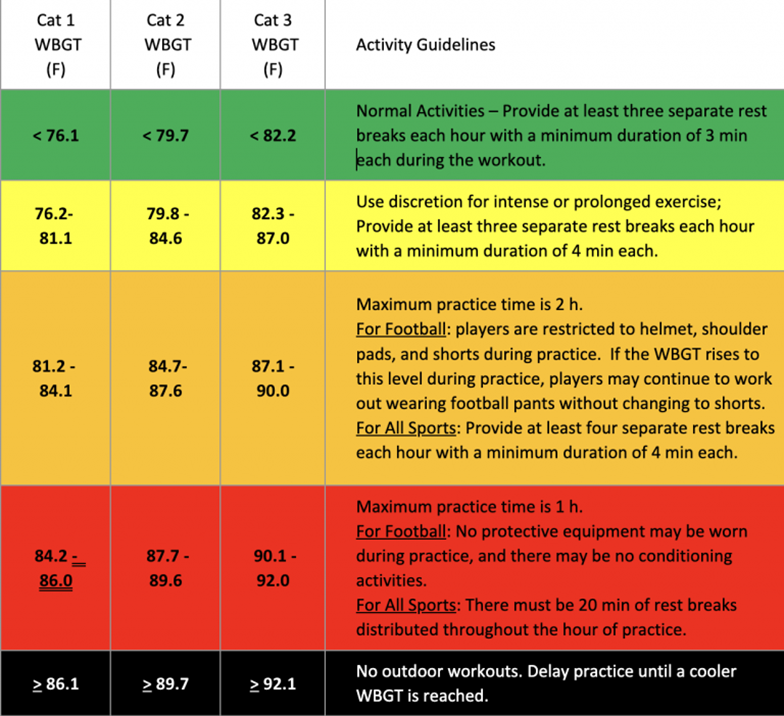
Wet Bulb Globe Thermometer (WBGT): Certified Athletic Trainers will use a WBGT to monitor temperatures and heat index. Athletic Trainer will utilize Chart A to determine heat index and guidelines for practice.
In the event of conditions of excessive heat are present, staff is expected to:
Monitor Weather – Certified Athletic Trainers are responsible to monitor heat environment with the use of WBGT prior to and during practices. In the event the Athletic Trainer is not onsite, coaches can refer to WBGT predictions from NWS: https://digital.weather.gov/
Conduct of Practice Sessions:
1. Thirty (30) minutes prior to the start of activity, temperature and humidity readings should be taken at the site.
2. The temperature and humidity should be factored utilizing a digital WBGT that calculates the Heat Index, that number may be used to apply to Chart A, Region Category 2.
3. If a reading is determined whereby activity is to be decreased, then re-readings would be required every thirty (30) minutes to determine if further activity should be eliminated or preventative steps taken, or if an increased level of activity can resume.
4. Using the following scale, activity should be altered and/or eliminated based on the WBGT reading as
determined.
5. This procedure is to be used until the temperature is below 84 degrees as no combination of heat and humidity at that level will result in a need to curtail activity.
Acute Management Plan & Care for Heat Illness:
Athletic Trainers should have necessary emergency equipment readily available in the event any symptoms of significant heat illness present. Rectal temperature must be obtained if symptoms are present. Refer to Athletic Trainer Standard Operating Procedures for Heat Illness. Coaches will follow guidelines based on their mandatory education and training. Call 911 or seek immediate emergency medical assistance.
Chart A: National Trail Local Schools will adhere to information regarding Category 2 Region.Wet Bulb Globe Temperature Monitoring | Korey Stringer Institute | College of Agriculture, Health and Natural Resources | University of Connecticut
Quick Reference Emergency Procedures
When an injury occurs on the field or court of play, the following EMERGENCY PROCEDURES should be followed whenever possible.
It is understood that the head coach is responsible for dealing with all injuries to his or her players in the event that an Athletic Trainer or Doctor is unavailable.
The following procedures should be taken when an injury occurs:
1. The Athletic Trainer or Doctor will go onto the field or court and evaluate the injured player(s).
2. If the injury is serious, the coach/ assistant coach or student trainer should call 911 and give the following information;
a. Your name
b. Exact location and address of the injured athlete(s)
c. The closest entrance information to the field or court nearest the athlete
d. Number of injured athletes and type of injury
e. Care being provided
f. Number you are calling from
g. Hang up last
3. Send someone to meet EMS
4. Contact the parents as soon as possible if they are not present at the sporting event or practice
5. Retrieve EMERGENCY MEDICAL CARD and any necessary medical equipment.
6. Control crowd to keep person safe
7. If the parents are unavailable, the player’s coach or assistant coach should accompany the athlete to the hospital.
NOTE: As a courtesy, a player’s coach should contact the parents to see how the injured player is doing. This call does not have to be for serious injuries only.
8. The Athletic Trainer will alert the head coach of a player’s status and when he or she may return to the game or practice
9. A report of all injuries should be kept in the Athletic Training Room, via Epic and/or FinalForms
a. Coaches should also keep a record of all injuries that happen under their supervision.
b. This is to prevent future liability issues from arising.
10. The school’s attendance and principal’s office should be notified regarding any serious injury to an athlete that may cause absence or special arrangements due to their injury.
11. It is not recommended, for insurance reasons, that any specific doctor or clinic be directed by a coach.
12. Emergency Medical Authorization Cards should be with the coach at ALL practices and games for that team, either via FinalForms or printed.
13. Coaches should keep their cell phones with them or in close proximity to them at all times in case of an emergency.
14. All coaches should have keys to all the necessary gates and entrances to practice or game facilities. This should promote fast and prompt care to a seriously injured athlete.
NOTE: If there is ever any doubt about the condition of an injured athlete call 911!!!
